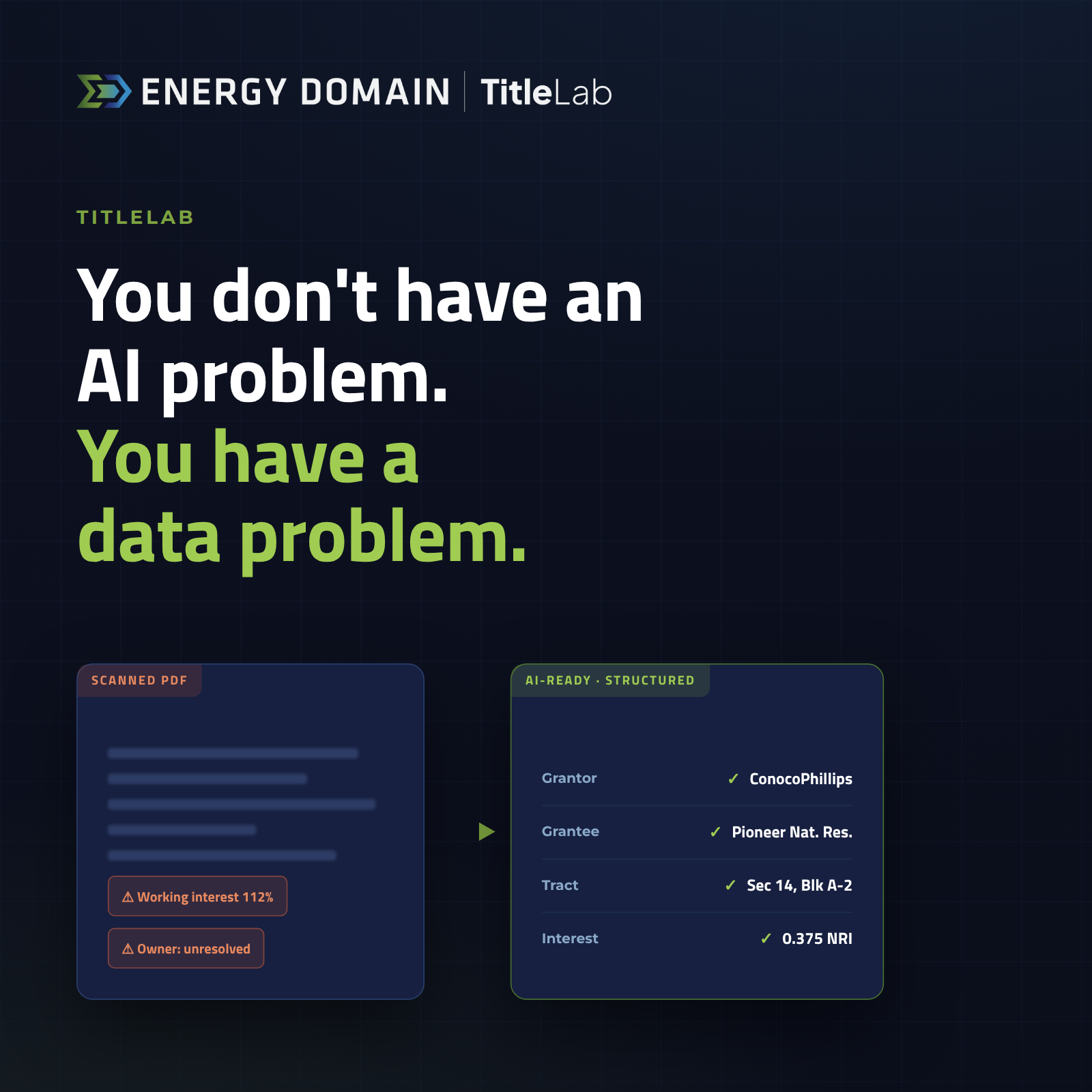
Land teams are pointing AI at title work and getting guesswork back. The bottleneck isn’t the model. It’s what you’re feeding it.
Every land team we talk to is trying to point AI at their title work: feed the courthouse PDFs into a model, ask for a runsheet, save a week. Most hit the same wall. The model gives back guesswork. An owner that doesn’t exist, a working interest over 100% with no flag, a chain that looks clean and isn’t. Plus a token bill for the privilege.
It’s easy to blame the model. The problem is the data you’re feeding it.
A scanned PDF is not data
A courthouse instrument scanned to PDF is a picture of a page. To a language model it’s a wall of pixels to re-read and re-tokenize every time you ask a question. It doesn’t know which name is a grantor, which numbers are a legal description, or that “COP” and “ConocoPhillips” are the same operator. So it approximates. You can’t hand approximation to a title opinion.
The “AI slop” comes from unstructured input, not a weak model.
What AI-ready data means
Models reason well over clean, typed fields and badly over image dumps. AI-ready title data means every instrument is already parsed into structure before the model ever sees it: parties normalized across name variants, every tract and legal description captured, conveyed interests and prior references linked ,exported as a structured index a human or a machine can query directly, with no re-OCR.
Hand a model that, and the questions that used to return guesses return answers: build the runsheet, flag the depth severances, pull every instrument with a continuous-drilling obligation. Now it’s working from real fields instead of a hopeful read of a scan.
Structure the data before the model sees it
Most teams skip this step. They invest in the model and starve the data, then wonder why the output can’t be trusted. TitleLab does the extraction and normalization up front, imaging every instrument, reading the source documents, structuring them, so the data you point your AI at is already clean. That’s the difference between a demo that impresses and a workflow you’d run a deal on.
The export is built for exactly this: search your legal, add the documents to your runsheet, and download a structured index your team and your models can both use. No re-OCR. No token burn on raw PDFs.
Clean data first. Then the AI works.
You don’t need a better model
You need data your model can reason over. The AI on your desk is probably good enough already. What’s missing is a clean, typed, queryable record of the courthouse underneath it. That’s what TitleLab is.
See what TitleLab captures in your county. Send us a legal description and we’ll show you the structured record on it, before you commit to anything.
