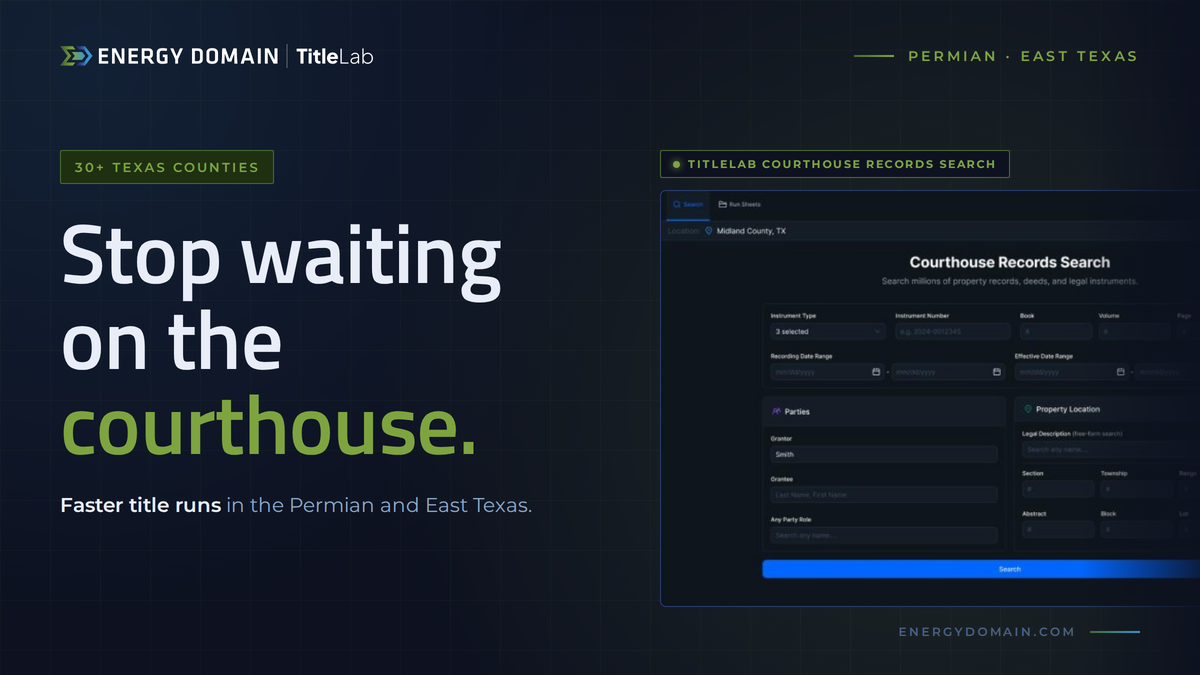
Every acquisition in the Permian or East Texas stalls at the courthouse. A landman gets a tract, a party, and a deadline, then spends days pulling deeds, running the chain, and checking what the seller says they own against what the record supports. The deal's economics are set long before that work is done, but the deal can't close until it is.
TitleLab closes the gap between "we like the acreage" and "we've confirmed the ownership."
The bottleneck is the pull, not the title work
Land teams are good at title. Getting the records in front of them is what takes time. A conventional run means a courthouse trip or a per-document order, a wait, and then manual entry of grantor, grantee, instrument type, and legal description into a run sheet before anyone calculates a single interest. Across a multi-section AOI (Area of Interest), the diligence window disappears.
TitleLab cuts that step. Courthouse records are indexed and searchable by tract and party across 20+ Permian Basin and East Texas counties. A landman searches the section, sees the instruments that touch it, and starts the chain from a structured index instead of a stack of paper.
From records to a defensible interest
What a land team needs from a run is a number they can stand behind, not a document count. TitleLab moves from indexed instruments to the ownership math: NMA (net mineral acres), NRA (net royalty acres), and the NRI (net revenue interest) a buyer would actually receive. When a memorandum of lease, an assignment, or an ORRI (overriding royalty interest) severs part of the interest, that severance flows through the calculation instead of sitting in a footnote someone forgets.
Mis-descriptions surface here too. A legal that doesn't tie back to the survey, a gap between two grantors, a depth severance that changes what's conveyed below a formation top: these findings protect a buyer or blow up a closing. Catch them during the run, not after the wire.
East Texas is where it pays off most
Permian title moves fast and in volume. East Texas, the Haynesville side, is harder: older chains, more heirship, more instruments per tract, and legals that predate clean survey references. That work punishes a manual pull. The land-service firms and non-op buyers working East Texas acreage in our pipeline this quarter are hitting it now.
Query the run instead of re-keying it
Title work rarely stays in one place. The runsheet feeds a valuation model, and the model feeds an offer. Getting there shouldn't mean retyping what the run already produced. Programmatic access to TitleLab through MCP (Model Context Protocol) is in development, so the structured output of a run (parties, dates, legal descriptions, depth severances, interests) can be pulled directly by the tools a land or data team already runs, with no manual re-entry.
