Ask a land team in the Delaware where a deal slows down. Almost none of them say the offer, the model, or the PSA. They say title. The section you need sits across three grantors, two of them dead and one a trust that reorganized in 1994, and the last instrument touching your tract is a correction assignment nobody indexed cleanly. Every acquisition, drilling decision, and division order downstream waits on someone reading those records in order.
TitleLab compresses that work. It won't replace the landman's judgment. The calls on ambiguity, the curative strategy, the read on a suspect conveyance stay yours. It collapses the hours you spend assembling the record before you can make those calls.
The runsheet is the job, and the courthouse is the problem
A runsheet is the chronological index of every recorded instrument affecting a tract, and it's the spine of every title opinion. Building one the old way means a courthouse trip or a county portal, book-and-page by book-and-page, transcribing grantor, grantee, instrument type, and legal description into a spreadsheet by hand. An active Permian section runs to hundreds of instruments: deeds, leases, assignments, mineral and ORRI (overriding royalty interest) conveyances, releases, probates, and the correction instruments that move an interest you'd miss if you skimmed.
TitleLab indexes those records and returns them as a structured, chronological set. You search by party, instrument type, and legal description across the 22 Texas Permian Basin counties live today: the Midland and Delaware core (Midland, Martin, Howard, Ector, Reeves, Loving, Ward, Crane, Pecos, Upton, and more), where most of the section trading happens. Lea and Eddy County on the New Mexico Delaware side, and East Texas, are coming next. The runsheet you'd spend two days assembling is your starting point.
Where the hours go back
Three places.
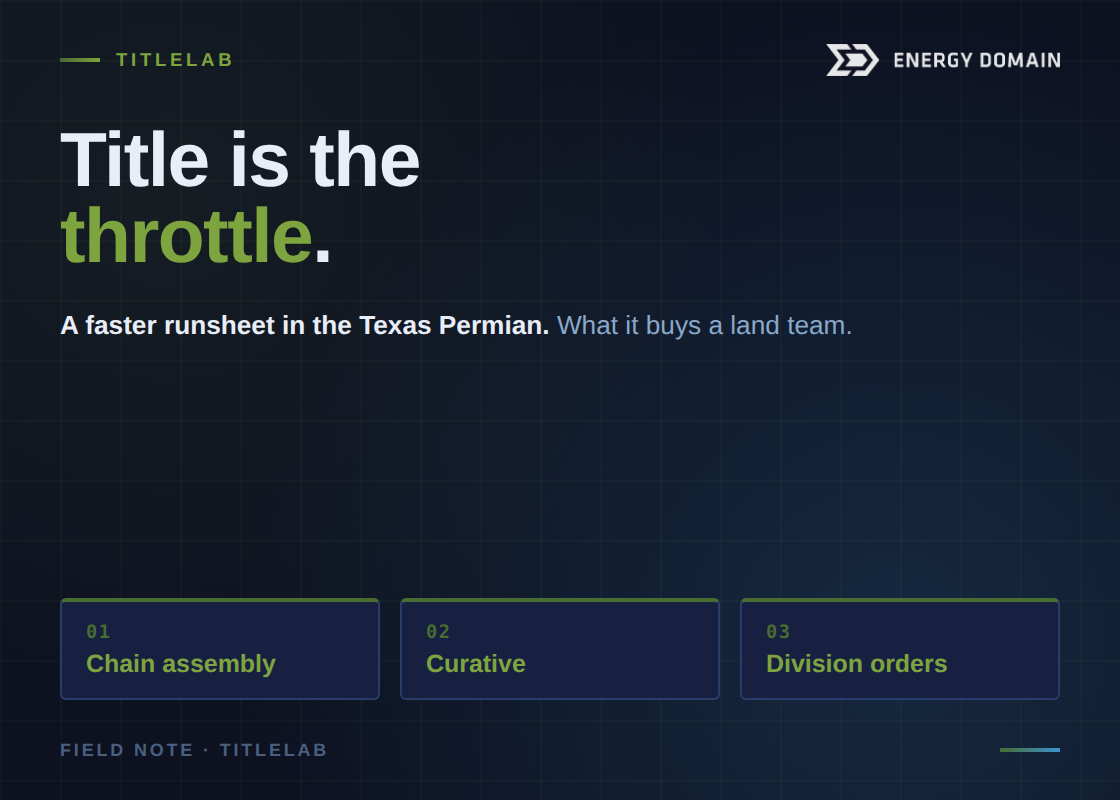
- Chain assembly. Instead of transcribing book-and-page into Excel, you pull the indexed record and read the chain in order. The grantor/grantee links are parsed, so a broken chain, an assignment that references a prior instrument nobody recorded, shows up as a gap instead of hiding in a line you skipped.
- Curative triage. Curative is where title schedules die. With the full set of instruments in front of you and filterable, you separate the defects that threaten the interest you're buying (a missing release on a senior lease, a mis-described tract, a probate that never cleared) from the noise. You triage in an afternoon instead of rebuilding the file first.
- Division-order support. Once a well produces, the division order analyst has to defend a decimal. A clean, sourced chain from the same records the opinion was built on means the NMA (net mineral acres) and NRA (net royalty acres) math traces to recorded instruments, not to a spreadsheet someone took with them when they left.
Live today
TitleLab's JSON export ships now. The same indexed record comes out as structured output, so a land-tech or data team pulls a runsheet into their own systems instead of re-keying it. (MCP access for TitleLab is in development.)
What it doesn't do, and why that matters
TitleLab doesn't render a title opinion. It doesn't decide whether a 1978 quitclaim conveyed the deep rights. It doesn't sign anything. If you want a tool that automates the landman out of the process, this isn't it, and be suspicious of anything that claims to. It gets the record in front of you, complete and in order and sourced to book and page, fast enough that the expensive part of your week is judgment instead of data entry.
The same Delaware sections trade again and again, and the team that closes first wins. What decides that is how fast you can trust the title.
See TitleLab against a live section in your AOI: request a walkthrough with your own Texas Permian tract, or get on the early-access list for Lea/Eddy and East Texas.
