What It Actually Takes to Replace the Data Stack

What It Actually Takes to Replace the Data Stack
A technical lead at a Fort Worth merchant bank asked us a sharp question on a recent discovery call. He'd been a petroleum engineer at a bulge-bracket bank before moving into investment banking, so he'd seen the inside of every major data vendor. His concern wasn't whether we had good data. It was whether replacing his incumbent would mean signing up for six different subscriptions to recover the same coverage.
He called it death by a thousand cuts. Each module priced separately, each renewal a fresh negotiation, each year another stack-up of incremental fees that the original sales conversation never mentioned.
That fear is the single biggest blocker we hear from buyers evaluating a switch. It's worth addressing directly.
The three things buyers actually need to leave the incumbent
Across recent conversations with a merchant bank, an energy-focused bank's mineral management group, and a subsurface engineering director at a PE-backed portco, the same three requirements surfaced.
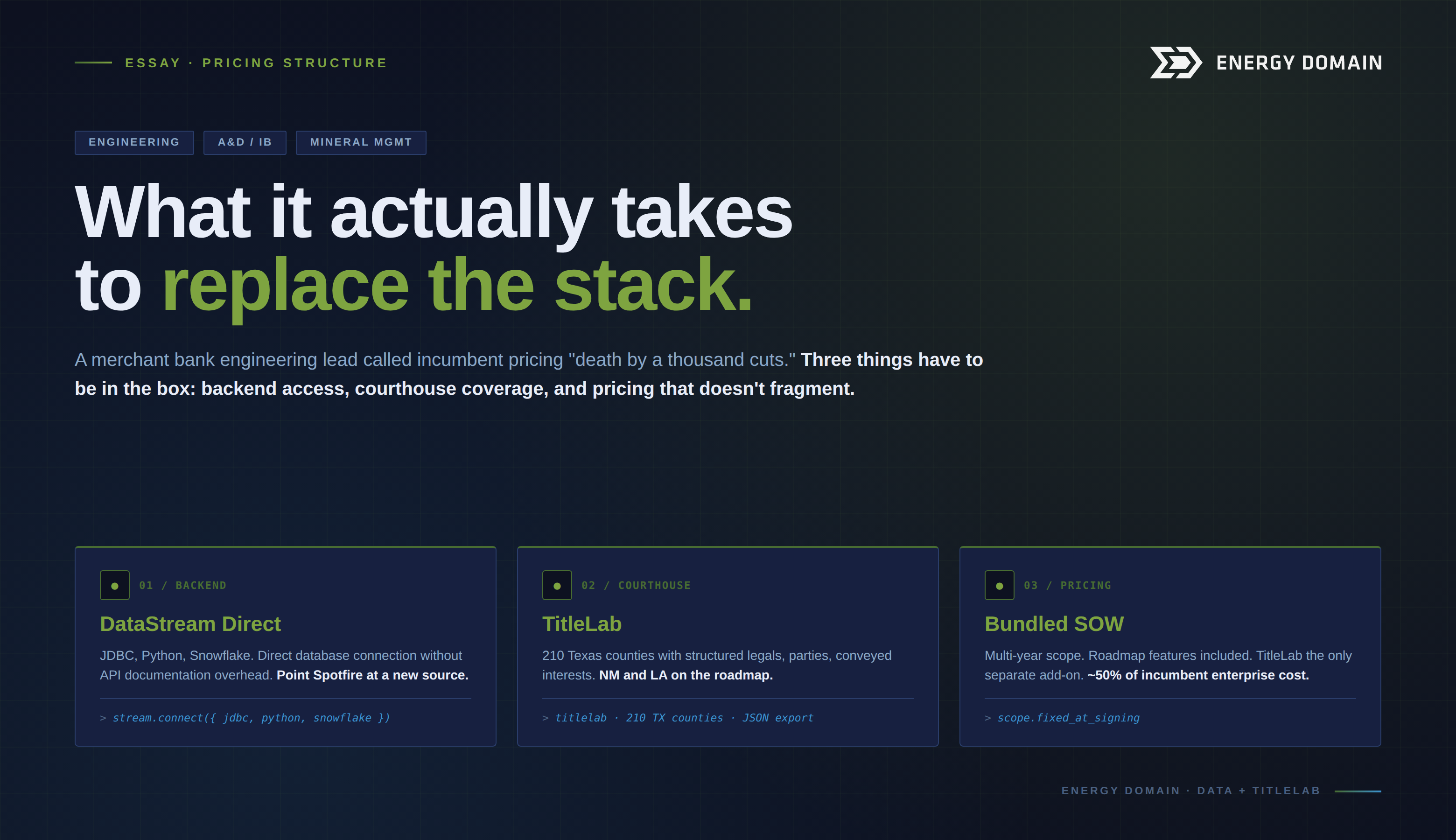
1. Backend access that doesn't require an integration team. The engineering director runs 90 percent of his work through Spotfire fed by an API into a SQL prod DB. The merchant bank lead doesn't use APIs heavily today, but wants direct database connection, Python, JDBC, Snowflake, without writing against complex API documentation. Both want to point their existing analytics tools at a new source and have the queries just work.
2. Courthouse coverage that's actually queryable. The energy bank's mineral management group is currently subscribed to a major incumbent's courthouse product. Their complaint isn't that it doesn't exist. It's that legal descriptions come back collapsed and incomplete, abstract coverage caps out at roughly 15 Texas counties, and anything more rigorous requires "bloated" upgrades. They build run sheets for clients. Incomplete legals mean manual reconstruction, every time.
3. Pricing that doesn't fragment. The merchant bank lead asked for budgetary ranges at 15, 20, and 30 seats, and was explicit that he needed to know what was in the box. Not which add-ons would be required next year. Not which features were behind a paywall and which weren't. The whole shape of the deal, up front.

What we offer against each
On backend access. DataStream Direct is the connector. The merchant bank lead asked for "non-traditional API" and that's the closest description. A direct database connection that bypasses the documentation overhead. WFS for geospatial feeds into internal mapping apps. The engineering director wanted exactly this and asked for an engineer-led session the following week to validate it on his Spotfire setup.
On courthouse. TitleLab covers 210 Texas counties with structured extraction of full legal descriptions, parties, instrument types, and conveyed interests. JSON export is live. MCP for TitleLab is in development. Permian counties are live first, with East Texas rolling out at three to four counties per week, and New Mexico (Lea, Eddy) and select Louisiana parishes on the roadmap. The energy bank's mineral management lead is waiting for full release before pulling his title team into a unified pilot. That's the right move and we told him so.
On pricing. Energy Domain runs roughly 50 percent of comparable incumbent enterprise scope. The merchant bank lead got a more direct answer than he expected. Features are bundled under multi-year SOWs, TitleLab is the only distinct add-on module, and we don't carve out incremental fees as the product grows. He noted, accurately, that the pricing model is unusual for the category.
The pilot structure
For most of these conversations, the path forward looks the same. A low-cost pilot with broad access across teams. CS-led onboarding and office hours. Transparent opt-in conversion pricing fixed at the start. Run it parallel to the incumbent if the contract overlaps. Decide on the strength of the buyer's own workflows, not on slideware.
The engineering director put it cleanest. He'll switch if and only if the data fidelity, freshness, and coverage hold up against his incumbent when streamed into his existing Spotfire stack. Anything he can't validate himself doesn't count.
That's a fair bar. We're built to clear it.
The honest part
Not every buyer has converted. Some have feature gaps that matter for their specific workflows. Historical rig time series. Offshore coverage. Multi-series comparative analytics. Certain custom calculated columns. We tell prospects which ones we don't have today and when they're shipping. The merchant bank lead has a parallel evaluation running with another vendor. He's not going to decide on one demo and we wouldn't want him to.
What's consistent across these calls is that the buyers most prepared to switch are the ones who've already done the math on their incumbent's price escalation, and the ones whose workflows have grown beyond what a UI-only product can support. Both groups are growing.
The thousand-cuts concern is real. The answer is to bundle the cuts and tell the buyer what's in the bundle.
Get the pricing in writing
If you're tired of guessing what next year's renewal will look like, we'll send you a fixed pricing scope for your team size and use case, with the conversion price set up front. No fragmented modules, no surprise add-ons.
That wraps the series. If your team is in the middle of an evaluation and want to compare notes, reach out. We've sat through enough of these in the last quarter that we can usually tell you within a call whether it's worth your time to keep going.